
When a small website has 10 or 20 pages, SEO is easier to manage. You can optimize each page, update content, fix technical issues, and track performance without too much complexity.
But when a website has hundreds or thousands of pages, SEO becomes more difficult. Large websites have more products, services, locations, categories, blogs, landing pages, and technical elements. Managing all of this with a basic SEO approach is not enough.
This is where enterprise SEO becomes important.
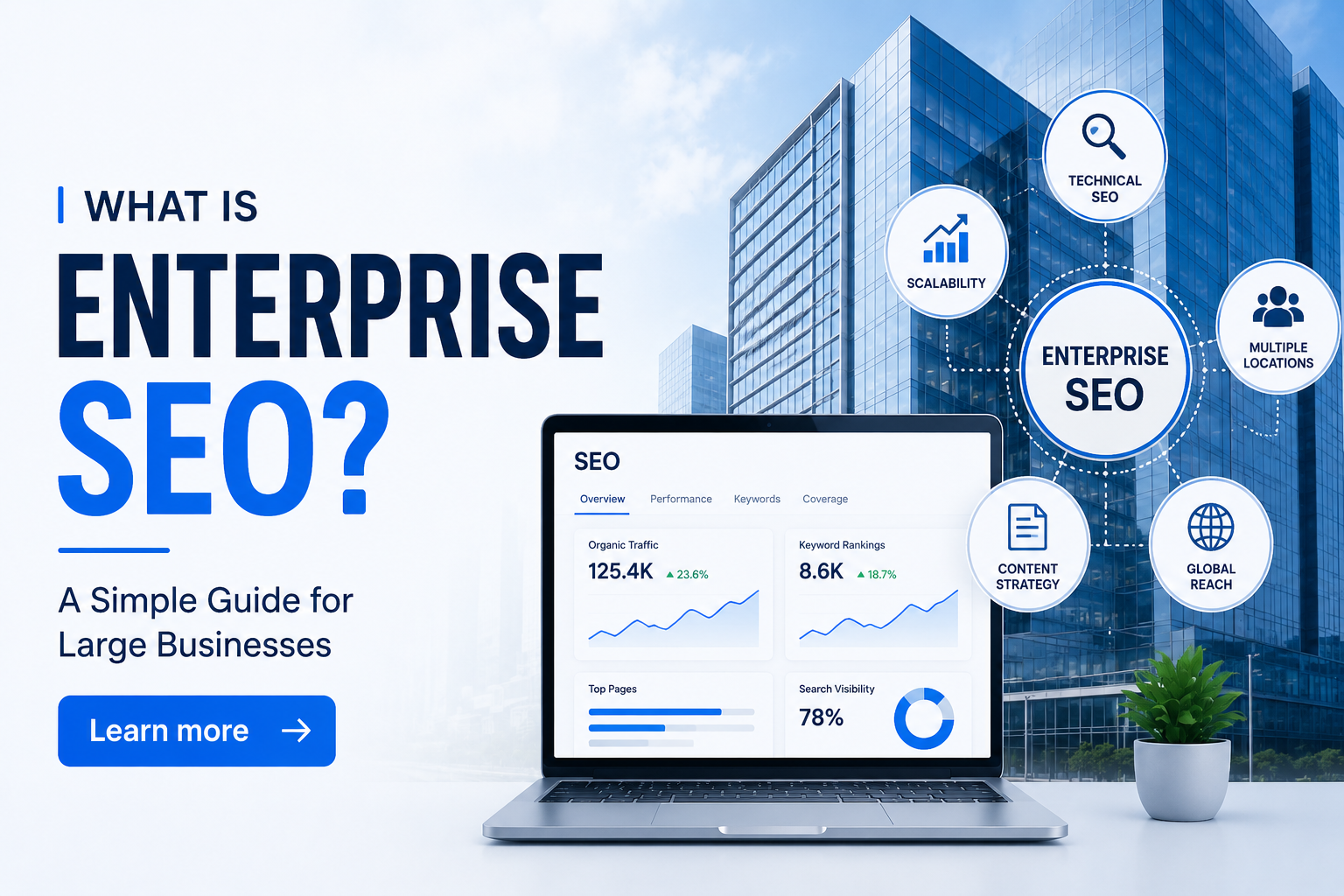
Enterprise SEO is the process of improving search visibility for large websites, big brands, ecommerce platforms, SaaS companies, multi-location businesses, and organizations that need SEO at scale.
In simple words, enterprise SEO helps large businesses manage their website’s organic growth in a more structured, planned, and scalable way.
What Is Enterprise SEO?
Enterprise SEO means search engine optimization for large and complex websites.
It focuses on improving website visibility across many pages, categories, locations, and search terms. Instead of optimizing only a few pages, enterprise SEO works across the full website structure.
For example, an ecommerce website may have thousands of product and category pages. A SaaS company may have many feature pages, solution pages, comparison pages, blogs, and landing pages. A multi-location business may have separate pages for different cities or branches.
Enterprise SEO helps these large websites stay organized, technically strong, and visible on Google.
It includes technical SEO, content strategy, keyword mapping, internal linking, website structure, reporting, and team coordination.
How Is Enterprise SEO Different From Regular SEO?
Regular SEO usually works for smaller websites with limited pages and simpler goals. Enterprise SEO is different because it deals with scale.
In enterprise SEO, a small issue can affect hundreds or thousands of pages. For example, if a page template has a technical mistake, it may create problems across many pages at once.
Enterprise SEO also involves more people. Content teams, developers, marketing teams, product teams, SEO teams, and business leaders may all be involved. This means the SEO strategy must be clear, organized, and easy to follow.
The main difference is not only website size. It is also the level of planning, technical control, reporting, and coordination required.
Why Is Enterprise SEO Important?
Enterprise SEO is important because large websites need a strong system to manage organic visibility.
When a large website is properly optimized, it can attract more organic traffic, improve search rankings, support lead generation, increase product discovery, and strengthen brand authority.
For large businesses, even small SEO improvements can create a big impact. If one technical fix improves hundreds of pages, the result can be much bigger than improving one page manually.
Enterprise SEO also helps protect existing rankings. Large websites often have many high-performing pages. Without proper SEO monitoring, traffic can drop because of technical errors, content changes, website redesigns, indexing issues, or poor internal linking.
A strong enterprise SEO strategy helps prevent these problems and supports long-term growth.
Core Areas of Enterprise SEO
Enterprise SEO covers many areas, but the most important parts are technical SEO, content strategy, website structure, internal linking, and reporting.
Enterprise Technical SEO
Technical SEO is one of the most important parts of enterprise SEO.
Large websites often face issues like slow loading speed, duplicate pages, crawl errors, indexing problems, broken links, poor mobile experience, and incorrect canonical tags.
If these issues are not fixed, search engines may struggle to crawl and understand the website properly.
Enterprise technical SEO helps make the website easier for search engines and users to access. It focuses on crawlability, indexability, site speed, mobile performance, structured data, Core Web Vitals, and clean website architecture.
Enterprise Content Strategy
Content is also a major part of enterprise SEO.
Large websites often have many pages with similar content. Some pages may be outdated, thin, duplicated, or not properly targeted to search intent.
An enterprise content strategy helps organize content across the website. It includes keyword mapping, content gap analysis, content updates, new page planning, and improving existing pages.
The goal is not to create content in bulk without value. The goal is to create useful, clear, and relevant content for different types of users.
Good content helps search engines understand the website better and helps users make better decisions.
Website Architecture and Internal Linking
Website architecture means how the pages are organized on a website.
For large websites, structure matters a lot. If important pages are buried too deep or not linked properly, users and search engines may not find them easily.
Internal linking helps connect related pages. It also helps pass authority to important pages and makes navigation easier.
For example, an ecommerce website should clearly connect category pages, product pages, blog guides, and buying pages. A service-based enterprise website should connect service pages, industry pages, case studies, and location pages.
A strong internal linking strategy helps both users and search engines move through the website smoothly.
Enterprise SEO Reporting
Enterprise SEO needs clear reporting because many teams and decision-makers are involved.
Reporting should not only show rankings. It should also show organic traffic, conversions, leads, revenue, indexed pages, technical issues, page performance, content growth, and SEO opportunities.
Good reporting helps teams understand what is working, what needs improvement, and where the business should focus next.
For enterprise websites, SEO reporting should connect search performance with business goals.
Common Enterprise SEO Challenges
Enterprise SEO comes with many challenges.
One common challenge is managing too many pages. When a website has thousands of pages, it is difficult to manually check every page.
Another challenge is duplicate content. Large websites often create similar pages for products, categories, locations, or services. If these pages do not have unique value, they may not perform well.
Technical changes can also create problems. Sometimes developers update website templates, URLs, navigation, or scripts without understanding the SEO impact.
Slow website speed is another issue. Large websites can become heavy because of images, scripts, plugins, and complex features.
Team coordination is also important. If content, SEO, development, and marketing teams are not aligned, SEO work can become slow or inconsistent.
Enterprise SEO solves these challenges by using proper systems, audits, workflows, and long-term planning.
Which Businesses Need Enterprise SEO?
Enterprise SEO is useful for businesses that manage large websites or complex online operations.
It is especially helpful for ecommerce websites, SaaS companies, franchise brands, multi-location businesses, real estate portals, healthcare networks, education platforms, media websites, B2B companies, and large service-based businesses.
You may need enterprise SEO if your website has many pages, many locations, many product categories, multiple teams, technical SEO issues, or large traffic goals.
You may also need it if your organic traffic is dropping, important pages are not ranking, or your website structure has become difficult to manage.
What Does an Enterprise SEO Strategy Include?
A proper enterprise SEO strategy usually starts with a detailed website audit. This helps identify technical issues, indexing problems, content gaps, duplicate pages, broken links, and website structure problems.
After that, keyword research and search intent mapping are done. This helps decide which pages should target which keywords and what type of content users need.
The next step is technical optimization. This may include improving site speed, mobile usability, crawlability, indexation, structured data, and page templates.
Content optimization is also important. Existing pages may need better headings, clearer information, updated content, stronger internal links, and improved user experience.
Enterprise SEO also includes internal linking planning, competitor analysis, reporting dashboards, and ongoing monitoring.
The goal is to build a scalable SEO system, not just optimize a few pages.
Benefits of Enterprise SEO
Enterprise SEO helps large businesses improve organic visibility at scale.
It can help more pages rank for relevant keywords, attract qualified traffic, improve website structure, reduce technical problems, and support better content performance.
It also helps teams work in a more organized way. Instead of random SEO changes, enterprise SEO gives a clear roadmap.
Another major benefit is long-term growth. Large websites need continuous SEO monitoring because search trends, competitors, website updates, and technical issues keep changing.
With enterprise SEO, businesses can build a stronger foundation for sustainable search performance.
When Should You Hire Enterprise SEO Services?
You should consider enterprise SEO services when your website becomes too large or complex to manage with basic SEO.
If your website has hundreds or thousands of pages, technical issues, duplicate content, indexing problems, poor internal linking, or declining organic traffic, it may be time for an enterprise SEO audit.
You may also need enterprise SEO support during website migration, redesign, CMS changes, international expansion, or multi-location growth.
An experienced enterprise SEO team can help you create a clear roadmap, fix technical issues, improve content, strengthen internal links, and track performance properly.
Final Thoughts
Enterprise SEO is not just normal SEO on a larger website. It is a structured approach to managing SEO at scale.
It helps large businesses improve technical SEO, content strategy, website architecture, internal linking, reporting, and overall organic visibility.
For large websites, small problems can create big losses. At the same time, small improvements can create big growth when applied across many pages.
If your website has grown beyond basic SEO, enterprise SEO can help you manage search visibility with more control, clarity, and long-term strategy.
FAQs About Enterprise SEO
What is enterprise SEO?
Enterprise SEO is the process of improving search visibility for large websites, big brands, ecommerce platforms, SaaS companies, and businesses that need SEO at scale.
How is enterprise SEO different from regular SEO?
Regular SEO usually focuses on smaller websites. Enterprise SEO handles larger websites with more pages, more technical issues, more teams, and more complex reporting.
Who needs enterprise SEO?
Enterprise SEO is useful for ecommerce websites, SaaS companies, multi-location businesses, franchise brands, large service websites, media platforms, and corporate websites.
Why is enterprise SEO important?
Enterprise SEO is important because it helps large websites improve visibility, manage technical issues, organize content, protect rankings, and grow organic traffic at scale.
What is included in enterprise SEO?
Enterprise SEO includes technical SEO, content strategy, keyword mapping, website architecture, internal linking, crawl management, reporting, and ongoing optimization.
Is enterprise SEO only for big companies?
Enterprise SEO is mainly for large businesses, but fast-growing websites with many pages, services, products, or locations may also need it.
How long does enterprise SEO take?
Enterprise SEO is a long-term process. The timeline depends on website size, technical issues, competition, content quality, and how quickly improvements are implemented.
Newsletter
Get the latest digital growth strategies delivered to your inbox.